Protecting your rental deposit in Korea starts before you sign the lease or send any money.
Jeonse and monthly-rent deposits in Korea can involve a large amount of money. There is no single step that protects the deposit by itself.
Getting a fixed date is not enough on its own, and joining a deposit-return guarantee does not make the other steps unnecessary.
In Korea, it is important to build several layers of protection in the right order:
Check the property and landlord → sign the lease → move in → register your address → obtain a fixed date → check deposit-return guarantee eligibility → recover your deposit when the lease ends
Korea does not have a separate set of residential tenancy protection rules for Vietnamese, American, Chinese, or other nationalities.
However, the administrative procedure for registering an address and the eligibility rules for some guarantee products may differ depending on whether a person is registered as a foreign resident, an overseas Korean, a Korean national residing abroad, or under another registration status.
So this guide focuses not on nationality, but on your registration status in Korea and the steps you need to complete.
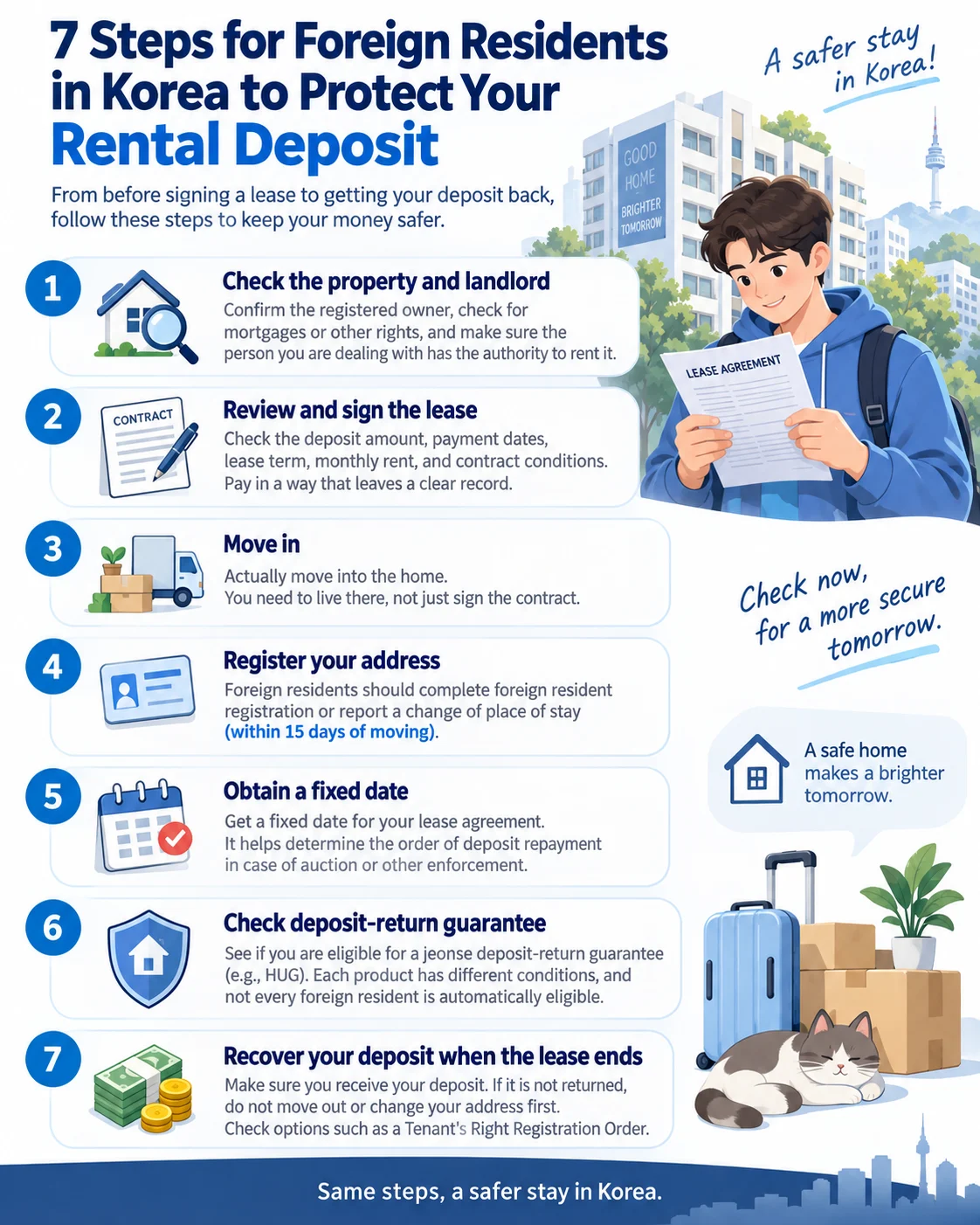
1. Check the property and the landlord before paying the contract deposit
Before signing anything, first confirm that the person you are dealing with actually has the legal authority to rent out the property.
In Korea, you will often hear people say deung-gi-bu-deung-bon (등기부등본). The current official name is the Real Estate Register Certificate, or 부동산 등기사항전부증명서.
This record can show who owns the property and whether rights such as mortgages or seizures have been registered against it.
Start by checking whether the landlord named in the lease matches the registered owner.
If someone else is signing on behalf of the owner, do not rely only on statements such as “I’m the owner’s family member.” Check whether that person actually has authority to sign the lease.
Pay particular attention to:
- whether the registered owner matches the person you are contracting with - whether there are large prior-ranking mortgages or other claims - whether there are seizure or provisional seizure registrations - whether the property is held in trust
A property registered under a trust arrangement can have a more complicated ownership and authority structure than an ordinary privately owned home.
In that situation, simply checking the name shown on the register may not be enough. The trust register and the authority to enter into the lease may also need to be checked.
한국어: 이 집 등기부등본을 확인하고 싶습니다. 발음 도움: Ee jip deung-gi-bu-deung-bon-eul hwak-in-ha-go sip-seum-ni-da. 뜻: I would like to check the property registry for this home.
For multi-family houses, the property register may not tell the whole story
A multi-family house may have several tenants living in the same building.
Deposits paid by tenants who moved in earlier may not all appear directly on the property register.
So it is risky to assume that the property is safe simply because there is not much mortgage debt shown on the register.
You may need to check information such as prior-ranking tenant deposits or fixed-date registration records.
The exact information you are allowed to inspect may also depend on the circumstances.
한국어: 선순위 보증금이 얼마나 있는지 확인하고 싶습니다. 발음 도움: Seon-sun-wi bo-jeung-geum-i eol-ma-na it-neun-ji hwak-in-ha-go sip-seum-ni-da. 뜻: I would like to check how much prior-ranking tenant deposit liability there is.
2. When signing the lease, check where the money is going
Once the property and ownership situation have been checked, review the lease itself.
Make sure the deposit amount, payment dates, lease term, monthly rent if applicable, and conditions for ending the lease match what you understood and agreed to.
Whenever possible, pay the deposit in a way that leaves a clear record of who received the money and how much was paid.
For HUG guarantee applications, documents that may be used to prove deposit payment include bank-transfer records, deposit slips, and receipts confirmed by the landlord or licensed real-estate agent.
Keep your transfer records after paying both the initial contract deposit and the remaining balance.
3. After moving in, complete the address-registration procedure that applies to you
One important part of protecting a rental deposit is showing that you actually occupy the home and that your address is officially registered.
Korean citizens usually hear this described as jeonip-singo (전입신고), or move-in registration.
For foreign residents, the relevant process may involve foreign resident registration or reporting a change of place of stay, depending on registration status.
According to current Korean government guidance, a foreign resident who moves to a new place of stay should report the change within 15 days of moving to the new address.
Depending on the case, the report may be made through the immigration office with jurisdiction over the address, or at a city, county, district, eup, myeon, or dong community service office.
Documents proving the new place of stay, such as the lease agreement, may be required.
한국어: 외국인 체류지 변경신고를 하려고 합니다. 발음 도움: Oe-guk-in che-ryu-ji byeon-gyeong-sin-go-reul ha-ryeo-go ham-ni-da. 뜻: I would like to report a change of my registered place of stay.
The important point is not that “foreigners cannot make a Korean move-in report, so they are not protected.”
Korean Supreme Court decisions have recognized that foreign resident registration and a reported change of place of stay can have a legal effect corresponding to resident registration when determining opposability under Korea’s residential tenancy protection system.
However, the administrative procedure is not identical for every foreign resident.
The procedure may differ depending on whether you are a registered foreign resident, an overseas Korean, a Korean national residing abroad, or another registration category.
Check the procedure that applies to your own registration status.
4. A fixed date has a separate role
After renting a home in Korea, you may often hear:
“Get a fixed date first.”
The Korean term is hwakjeong-ilja (확정일자).
In simple terms, it is a procedure that gives the lease agreement an officially recognized date.
That date can become important when determining the order in which deposit claims are paid if the property later goes through auction or another enforcement process.
한국어: 확정일자를 받고 싶습니다. 발음 도움: Hwak-jjeong-il-ja-reul bat-go sip-seum-ni-da. 뜻: I would like to obtain a fixed date for my lease.
One common misunderstanding is:
Getting a fixed date does not automatically make your deposit safe.
To obtain preferential repayment rights, the fixed date must be considered together with requirements such as actual occupancy and the relevant address registration.
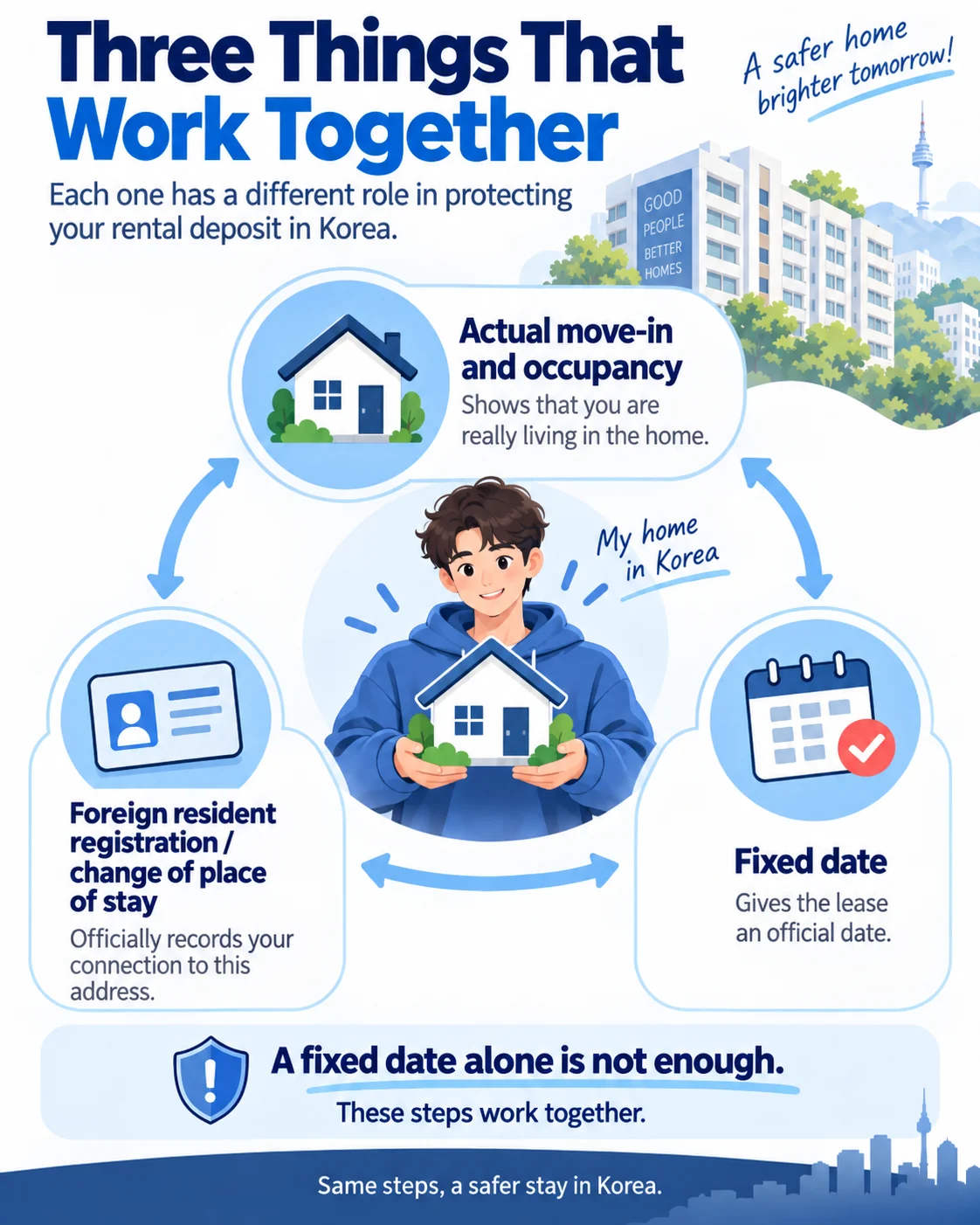
A simple way to understand the roles is:
- Actual move-in and occupancy → Are you actually living in the property? - Foreign resident registration or change-of-place-of-stay report → Is the relationship between you and this address officially recorded? - Fixed date → Is there an officially recognized date showing when the lease existed?
They serve different purposes.
Foreign residents can also obtain a fixed date.
Under the system confirmed for this article, foreign resident registration numbers can be used in fixed-date records, and a foreign resident registration card can be used as identification.
A fixed date can be obtained at locations such as a local community service center.
If the lease is subject to Korea’s residential lease reporting system, submitting the lease through that process may also result in a fixed date being assigned.
As of September 16, 2026, the current residential lease reporting system generally applies in designated areas when the deposit exceeds KRW 60 million or the monthly rent exceeds KRW 300,000.
The report is generally required within 30 days of signing the lease.
However, official online guidance is not completely consistent about the authentication methods available to foreign residents.
If online authentication does not work, checking directly with a local community service center is a practical option.
5. Check whether you can join a deposit-return guarantee
After checking the property and lease, moving in, registering your address, and obtaining the fixed date, you can also check whether you are eligible for a jeonse deposit-return guarantee.
Under the current HUG system, foreign tenants who meet the required conditions may apply for the Jeonse Deposit Return Guarantee.
This does not mean that every foreign resident is automatically eligible.
Eligibility depends on conditions including the type of property, the deposit amount, the rights registered against the property, the status of the lease, and whether the required tenancy protections have been established.
As of September 16, 2026, HUG’s general deposit-return guarantee currently lists a maximum jeonse deposit of:
- KRW 700 million or less in the Seoul metropolitan area - KRW 500 million or less in other regions
The current application deadline is generally before half of the lease term has passed.
A deposit under a monthly-rent lease may also be relevant to deposit protection and guarantee review, so do not assume that monthly-rent tenants are outside the system.
한국어: 이 집은 전세보증금반환보증 가입이 가능한가요? 발음 도움: Ee jip-eun jeon-se bo-jeung-geum ban-hwan-bo-jeung ga-ip-i ga-neung-han-ga-yo? 뜻: Is this home eligible for the jeonse deposit-return guarantee?
Not every HUG product has the same rules for foreign residents
The names of Korean housing guarantee products can sound very similar.
According to the material confirmed for this article, a qualifying foreign tenant may apply for HUG’s Jeonse Deposit Return Guarantee.
However, HUG’s Jeonse Loan Safety Guarantee has different eligibility rules for foreign residents and overseas Koreans.
The Korea Housing Finance Corporation, or HF, currently states that all tenants applying for its Jeonse Jikim Guarantee must be Korean nationals.
The latest official eligibility rules for foreign tenants under SGI Seoul Guarantee’s general rental-deposit guarantee were not sufficiently confirmed during this review, so this article does not state that foreign residents are either eligible or ineligible.
Do not look only at the name of the institution.
Check the exact product name and the applicant eligibility requirements.
If mobile application does not work, that does not automatically mean you are ineligible
HUG provides mobile and online application channels.
However, the official material reviewed for this article does not clearly confirm that foreign residents can use every mobile channel in the same way with foreign-resident identity verification.
If phone verification or an app does not work, do not immediately assume that foreign residents are excluded.
Check whether another application route is available through a HUG branch or participating bank.
6. You must keep the rights you established during the lease
The protection steps you completed at the beginning are not necessarily something you can forget about afterward.
Changing your actual occupancy or registered address during the lease can affect your tenancy rights.
This becomes especially important when the lease is ending but the landlord has not yet returned the deposit.
Do not assume that you can remove your address registration first simply because you have joined a guarantee product.
The conditions of the guarantee product and the legal requirements for maintaining tenancy rights need to be considered separately.
7. If you have not received your deposit, do not move out first without checking your rights
If the lease has ended and the landlord still has not returned your deposit, the situation can become urgent.
You may already have signed a lease for another home or arranged a moving date.
But moving out or changing your registered address before receiving the deposit can create problems with maintaining rights you previously established.
One legal procedure that may be available is the Tenant’s Right Registration Order, known in Korean as imcha-gwon-deung-gi-myeong-nyeong (임차권등기명령).
When a lease has ended but the deposit has not been returned, a tenant may apply to the court for this registration.
Once the tenant’s right registration has actually been completed, it can provide a legal mechanism for preserving existing opposability and preferential repayment rights while allowing the tenant to move.
The important point is not:
“I filed the application, so I can move immediately.”
It is important to confirm that the registration itself has been completed before changing your address or giving up possession.
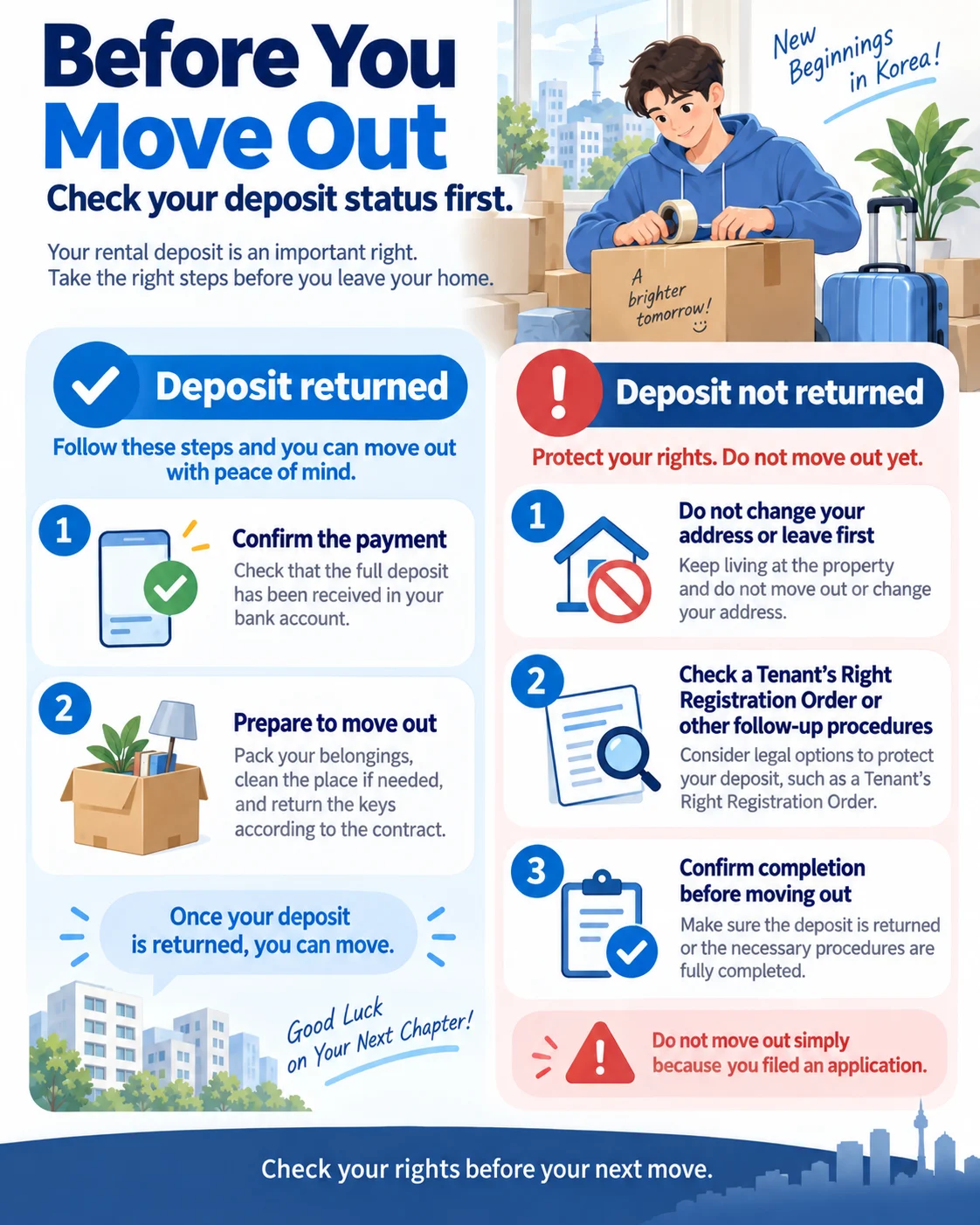
Check these three moments
You do not need to memorize every Korean legal term.
It is more useful to remember what to check at the three moments when your money and rights are most exposed.
Before sending money
Check the property register and the registered owner.
Look for mortgages, seizures, trust registration, and other prior-ranking rights.
For a multi-family house, also consider whether prior-ranking tenant deposits need to be checked separately.
If the person signing the lease is not the registered owner, confirm that person’s authority to act for the owner.
Immediately after moving in
Actually move into the home and complete the address-reporting procedure that applies to your registration status.
Check whether you have obtained the fixed date.
If the lease is subject to residential lease reporting, also confirm whether that report has been completed.
If you want to use a deposit-return guarantee, check your eligibility before the application deadline passes.
Before moving out
First confirm whether the deposit has actually been returned.
If you have not received it, do not simply change your address first.
Check how to preserve your opposability and preferential repayment rights.
If necessary, consider procedures such as a Tenant’s Right Registration Order.
There is no single step that can guarantee the safety of a rental deposit in Korea.
But once you identify which stage you are at, the next action becomes much clearer.
Before signing, check the property and its legal rights. After moving in, check your place-of-stay registration and fixed date. If the lease is ending and the deposit has not been returned, do not move first without checking how to preserve your rights.
Keep that sequence in mind.
Information Check and Updates
- First checked: September 16, 2026 - Last rechecked: September 16, 2026 - Update: HUG changes scheduled for October 1 and October 30, 2026 were reviewed separately from the rules currently in force
This article was checked against publicly available official information as of September 16, 2026, including Korea’s Housing Lease Protection Act and relevant Supreme Court decisions, the Government24 guidance on foreign residents reporting a change of place of stay, the Ministry of Land’s Real Estate Transaction Management System, HUG’s deposit-return guarantee and jeonse-fraud prevention materials, and HF’s guarantee guidance.
HUG has announced changes scheduled for October 1, 2026 and a broader jeonse guarantee system revision scheduled for October 30, 2026.
As of September 16, 2026, those changes had not yet taken effect.
The actual implementation should be checked again after October 1 and October 30.
Guarantee limits, deadlines, required documents, application channels, and online identity-verification procedures may change. Check the relevant institution’s official guidance again before signing a lease or submitting an application.
살아는 봅시다.