If you have arrived in Korea and plan to stay for more than 90 days, one of the first administrative procedures you should check is foreigner registration.
At first, terms such as HiKorea, immigration office, status of stay, and proof of residence can feel confusing.
But the process itself is fairly simple.
Check whether you need to register → Find your local immigration office → Check whether you need an appointment → Prepare your documents → Visit and apply → Receive your Foreigner Registration Card
Start by remembering this basic flow.
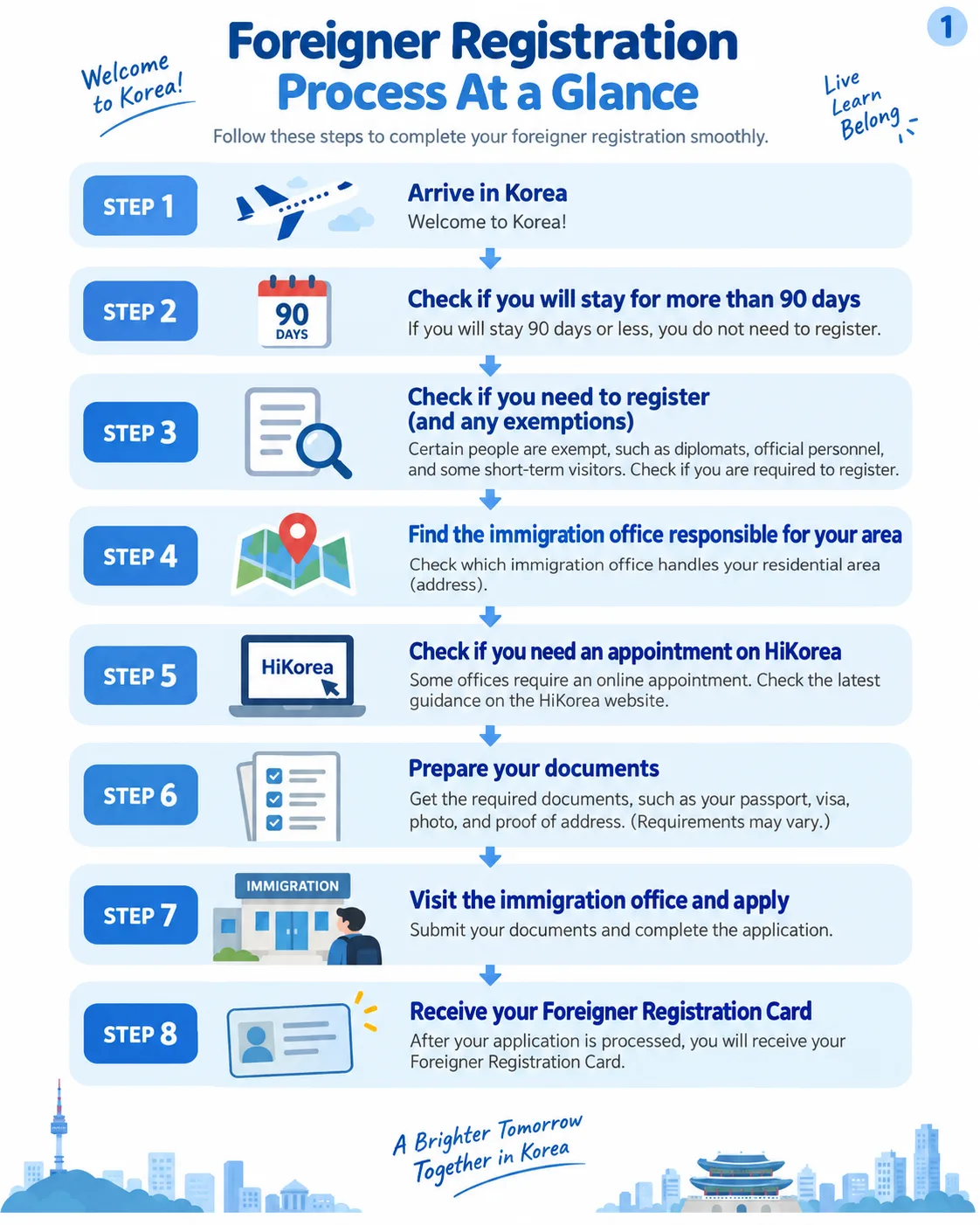
First, check whether you need to register
As a general rule, a foreign national who plans to stay in Korea for more than 90 days from the date of entry must apply for foreigner registration within 90 days of entering Korea.
The important phrase here is “as a general rule.”
Not every foreign national staying longer than 90 days is treated exactly the same. Some people, such as certain members of foreign diplomatic missions or international organizations, may be exempt from foreigner registration.
So the first question is simple:
Do I plan to stay in Korea for more than 90 days?
If the answer is yes, check whether foreigner registration applies to you and then move on to the next step.
When do I need to register?
The general deadline is within 90 days of entering Korea.
The 90-day period is based on the date you entered Korea, not the day you started looking into registration or the day you found a place to live.
If you are unsure about your status of stay or whether you need to register, it is better to check early rather than wait until the deadline is close.
Depending on your situation, the required procedure may differ. You can check through HiKorea or contact the Immigration Contact Center at 1345.
Where do I apply?
Foreigner registration is not a process where you apply online and simply wait for a card to be delivered.
In general, you need to visit the immigration office, branch office, or local office responsible for the area where you live.
Government24 also lists foreigner registration as an in-person application procedure.
Find the immigration office responsible for where you live
There are several immigration offices in Korea, so you should first check which office is responsible for your place of residence rather than visiting any office at random.
“Place of residence” does not need to sound complicated.
It simply means:
the place where you are currently living in Korea.
Check appointment requirements on HiKorea
When preparing for foreigner registration, use HiKorea to check the immigration office responsible for your area and whether you need to make an appointment.
If an appointment is required, check which dates are available.
One thing is important:
Making an appointment on HiKorea does not mean your foreigner registration is complete.
The appointment is part of preparing to visit the immigration office. You still need to bring the required documents and submit your application at the responsible office.
What do I need to prepare?
For a first-time application, you generally need to check your passport, photo, proof of residence, and any additional documents required for your status of stay.
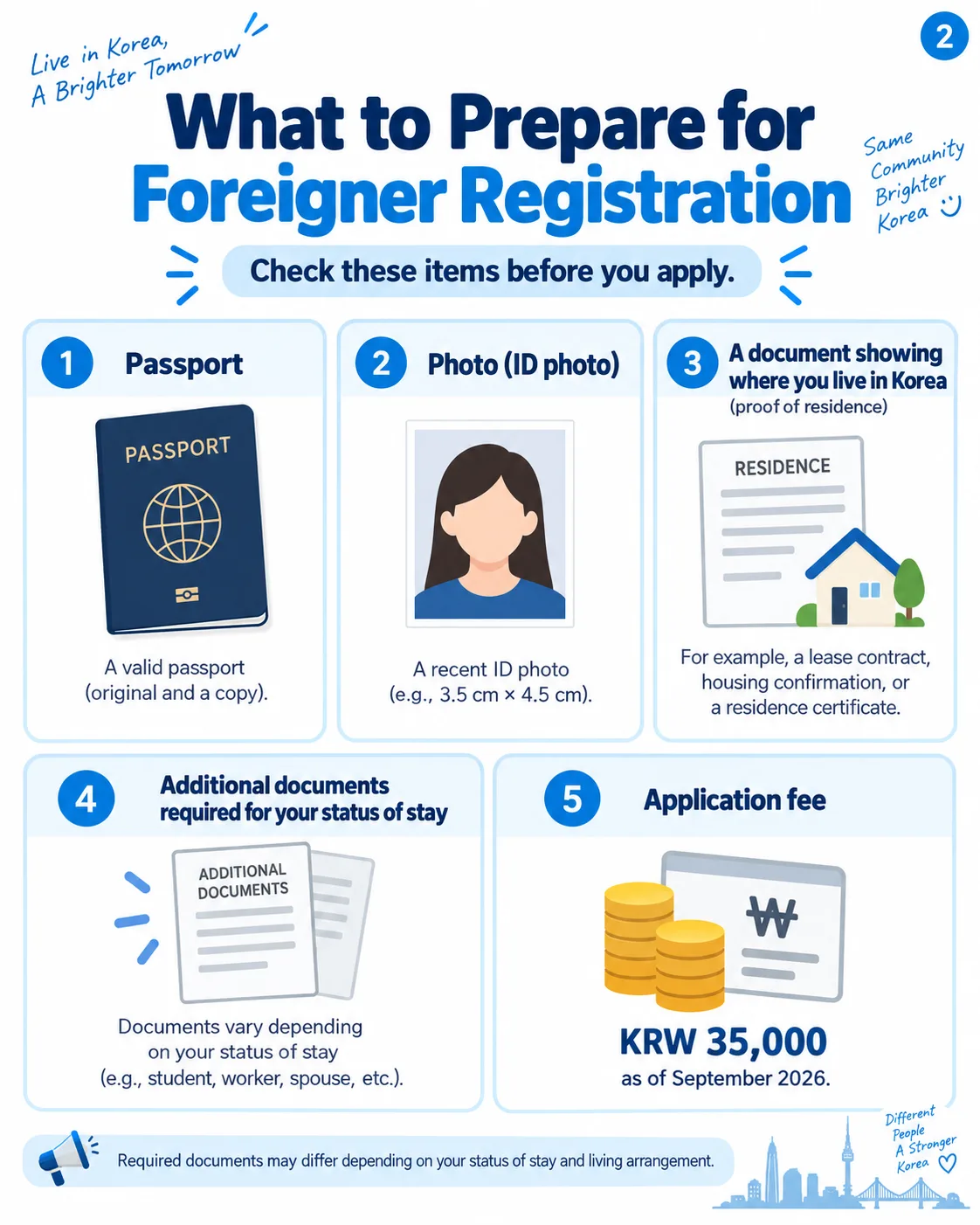
Before you apply, check that you have:
Passport Photo A document showing where you live in Korea Additional documents required for your status of stay Application fee
Note: Required documents may differ depending on your status of stay and living arrangement.
Documents showing where you live in Korea
Official guidance may refer to this as proof of residence.
In simple terms, it means:
a document showing, “This is where I currently live in Korea.”
You may rent a home in your own name, live in a university dormitory, stay in company housing, or live at a home rented or owned by a friend or spouse.
Because living arrangements differ, the documents accepted as proof of residence may also differ.
Check which documents apply to your situation.
Additional documents depend on your status of stay
Not every foreign national submits exactly the same documents.
International students, workers, marriage immigrants, and people with other statuses of stay may need different additional documents.
So instead of relying only on a checklist you found online, check the additional documents required for your own status of stay before you visit.
What happens when I visit the immigration office?
Once you are ready, take the required documents to the immigration office responsible for your area and apply for foreigner registration.
If you made an appointment, visit on your reserved date.
It is important to understand that submitting your foreigner registration application and receiving the physical card are not necessarily the same step.
Applying does not mean you will always receive the physical card immediately.
The actual time needed to receive the card may vary depending on the immigration office and its workload, so it is difficult to give one fixed number of days that applies nationwide.
How much does foreigner registration cost?
As of September 2026, the foreigner registration fee is KRW 35,000.
Some older information online may still list the fee as KRW 30,000.
The fee changed from KRW 30,000 to KRW 35,000 on January 1, 2025, when Foreigner Registration Cards with IC chips were introduced.
Administrative fees can change, so it is safest to check the latest information again before your visit.
The “3 hours” shown on Government24 does not mean your card will be ready in 3 hours
When you look at the foreigner registration information on Government24, you may see the processing time shown as “immediate (within 3 working hours).”
Do not read this as:
“If I apply for a Foreigner Registration Card, I will receive the card within 3 hours.”
That wording refers to the administrative processing period shown for the civil service procedure. It does not mean that a physical Foreigner Registration Card will be produced and handed to you within three hours.
For the actual card collection date, follow the instructions given by the immigration office where you applied.
After receiving your card, you can also use a mobile ID
Since 2025, Foreigner Registration Cards have included IC chips, and a mobile Foreigner Registration Card system is also available.
But do not confuse the order.
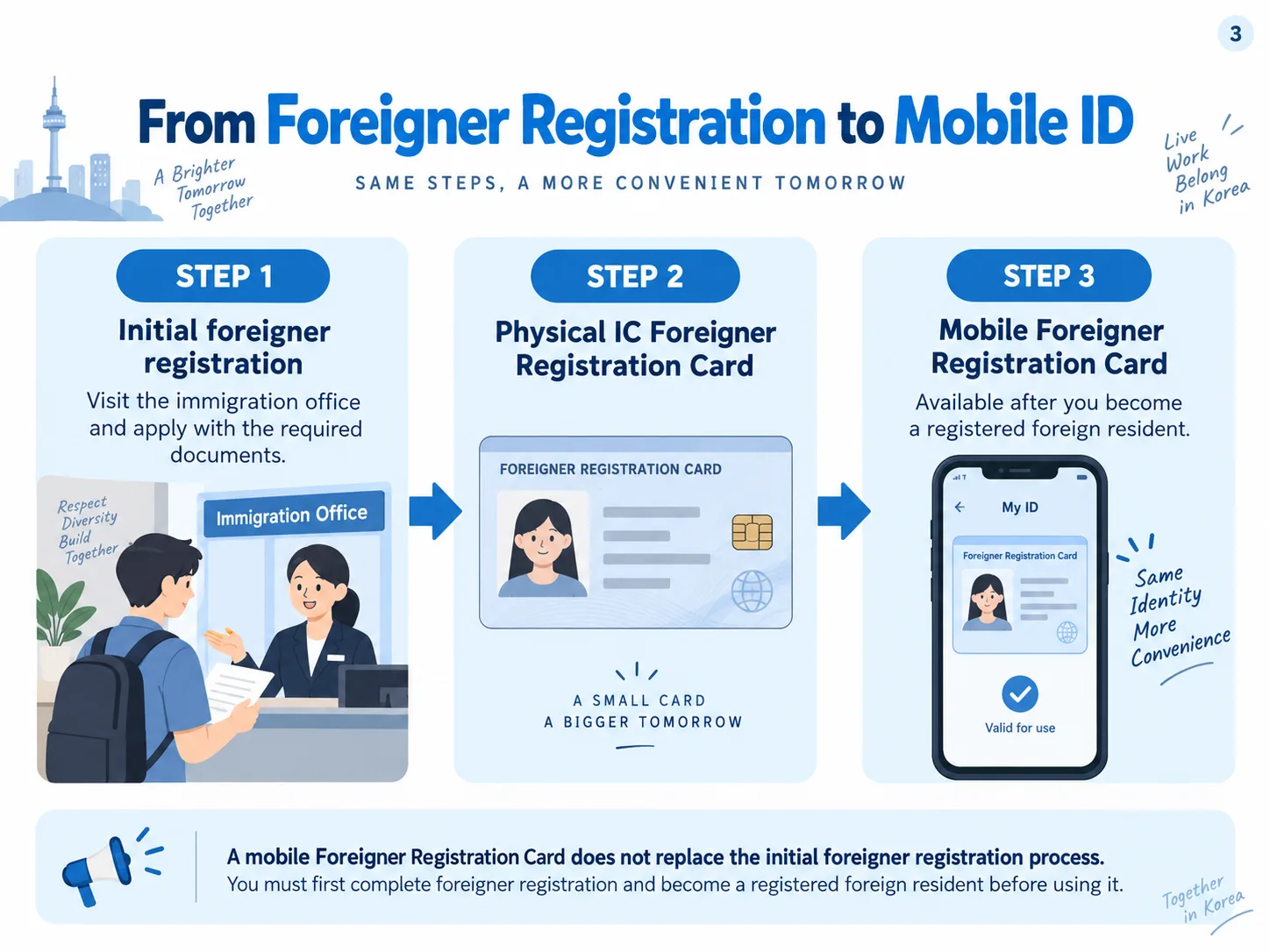
First foreigner registration ↓ Physical IC Foreigner Registration Card ↓ Mobile Foreigner Registration Card available after you become a registered foreign resident
A mobile Foreigner Registration Card does not replace the initial foreigner registration process.
You must first complete foreigner registration and become a registered foreign resident before using it as a separate mobile form of identification.
The detailed process for getting the mobile ID is separate from the initial foreigner registration process, so it is easier to check that procedure separately.
If Korean-language guidance is difficult, call 1345
If you are not sure which documents are required for your status of stay, or if official Korean-language guidance is difficult to understand, you can contact the Immigration Contact Center at 1345.
The 1345 service provides immigration and stay-related information and currently supports 20 languages.
You do not need to rely only on old information online or on someone else’s experience if Korean-language guidance is difficult for you.
For things that can vary by individual situation, such as documents required for a particular status of stay, it is better to confirm through 1345 or the immigration office responsible for your area.
After receiving your Foreigner Registration Card, start preparing for daily life in Korea
Once you have your Foreigner Registration Card, it becomes easier to handle many situations in Korea that require identity verification.
From there, you can start dealing with the practical parts of daily life one by one.
For example:
Mobile phone service → Bank account → Health insurance → Hospital visits → Housing and address-related administration
These are the kinds of issues that naturally come after foreigner registration.
You do not need to understand every part of Korea’s administrative system from the beginning.
Foreigner registration is the same.
Check whether you need to register → Check the deadline → Find your immigration office → Check whether an appointment is required → Prepare your documents → Visit and apply → Receive your card
Take it one step at a time.
Because required documents can differ depending on your status of stay, check your situation again through HiKorea or 1345 before visiting.