If you are sick but cannot explain in Korean where or how you are hurting, even going into a clinic or hospital can feel difficult.
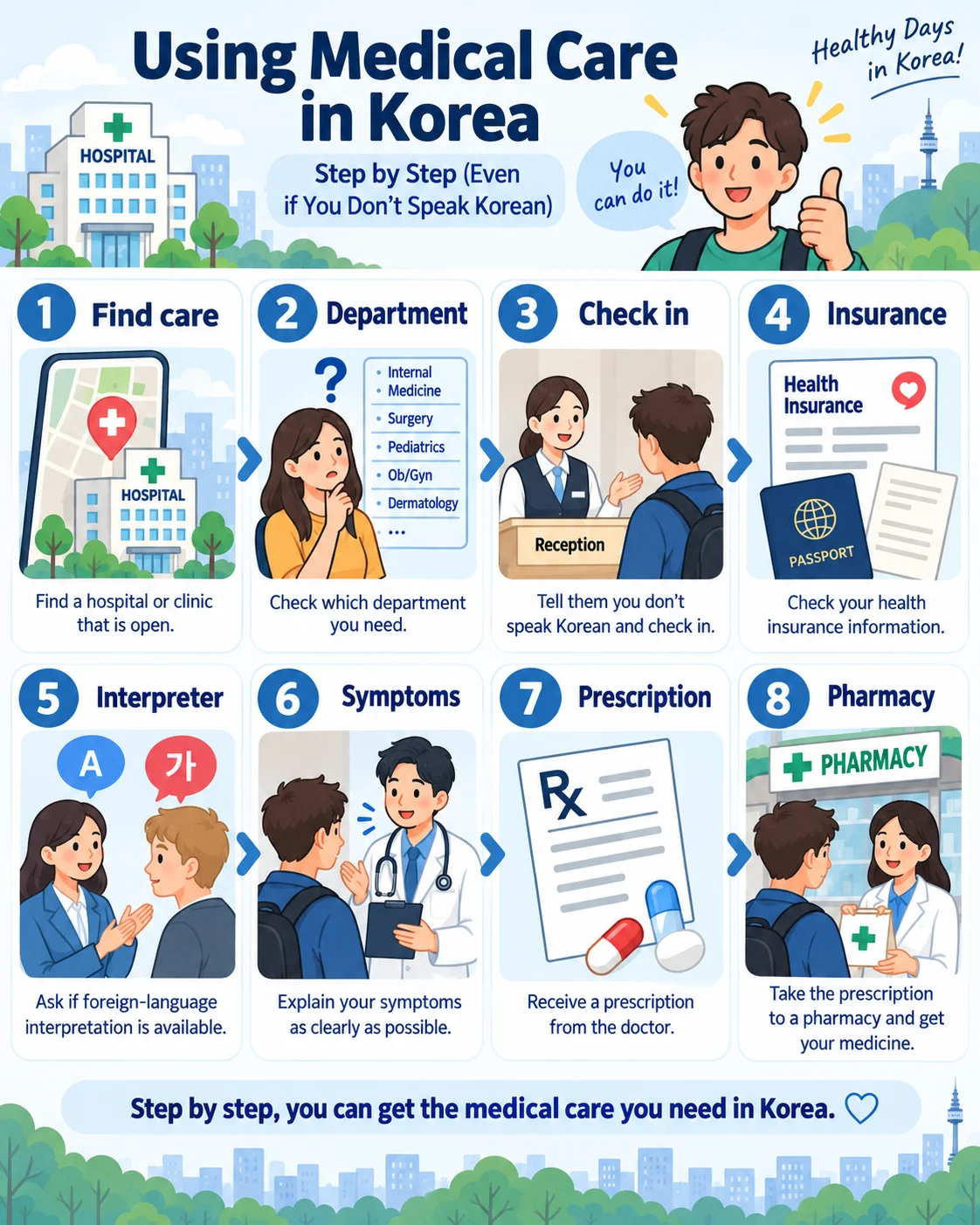
Getting medical care in Korea may involve several steps: finding a medical facility, choosing the right department, checking in, confirming health insurance, asking for interpretation, explaining your symptoms, understanding the doctor’s instructions, receiving a prescription, and going to a pharmacy.
If you are not comfortable speaking Korean, these problems can appear all at once.
This guide focuses less on explaining the entire Korean healthcare system and more on what you can actually do, step by step, when you need medical care in Korea.
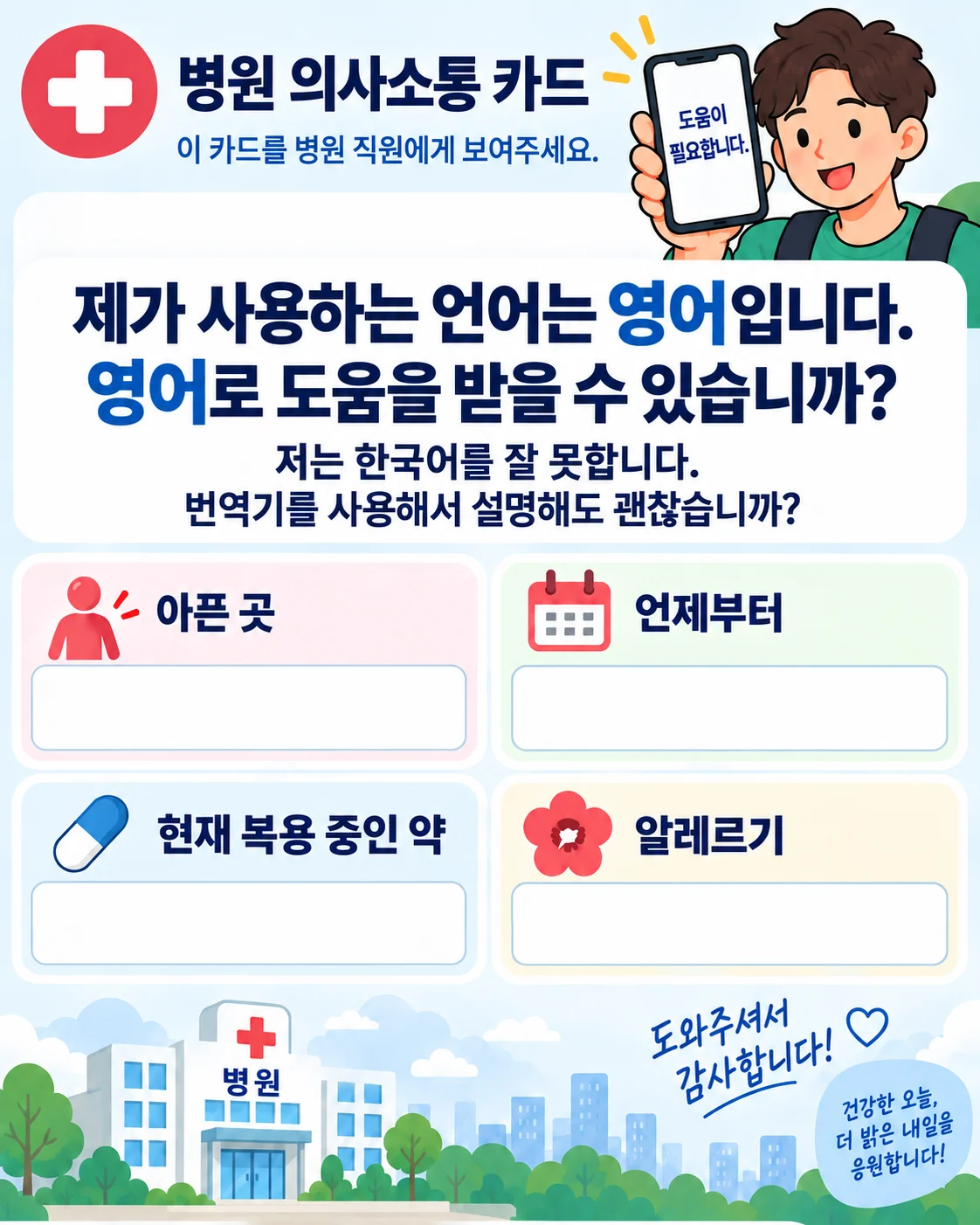
You can show the Korean sentences in this guide directly to hospital staff when needed. If a sentence contains information about symptoms, medicines, or allergies, change it so that it matches your actual situation.
First, check whether you need regular medical care or emergency help
Before searching for a clinic or hospital, there is one important distinction to make.
Do you need regular medical care, or urgent rescue and emergency medical assistance?
This guide does not diagnose illnesses or decide whether a symptom is an emergency. However, if you or someone around you believes urgent rescue or emergency medical assistance is needed, use 119 rather than spending time searching for a regular clinic.
Use 119 for urgent rescue and emergency medical assistance
In Korea, 119 is used for fire, rescue, and emergency medical assistance.
Multilingual information and interpretation support systems are available for foreigners, but the information checked for this guide does not support saying that every language is always available immediately.
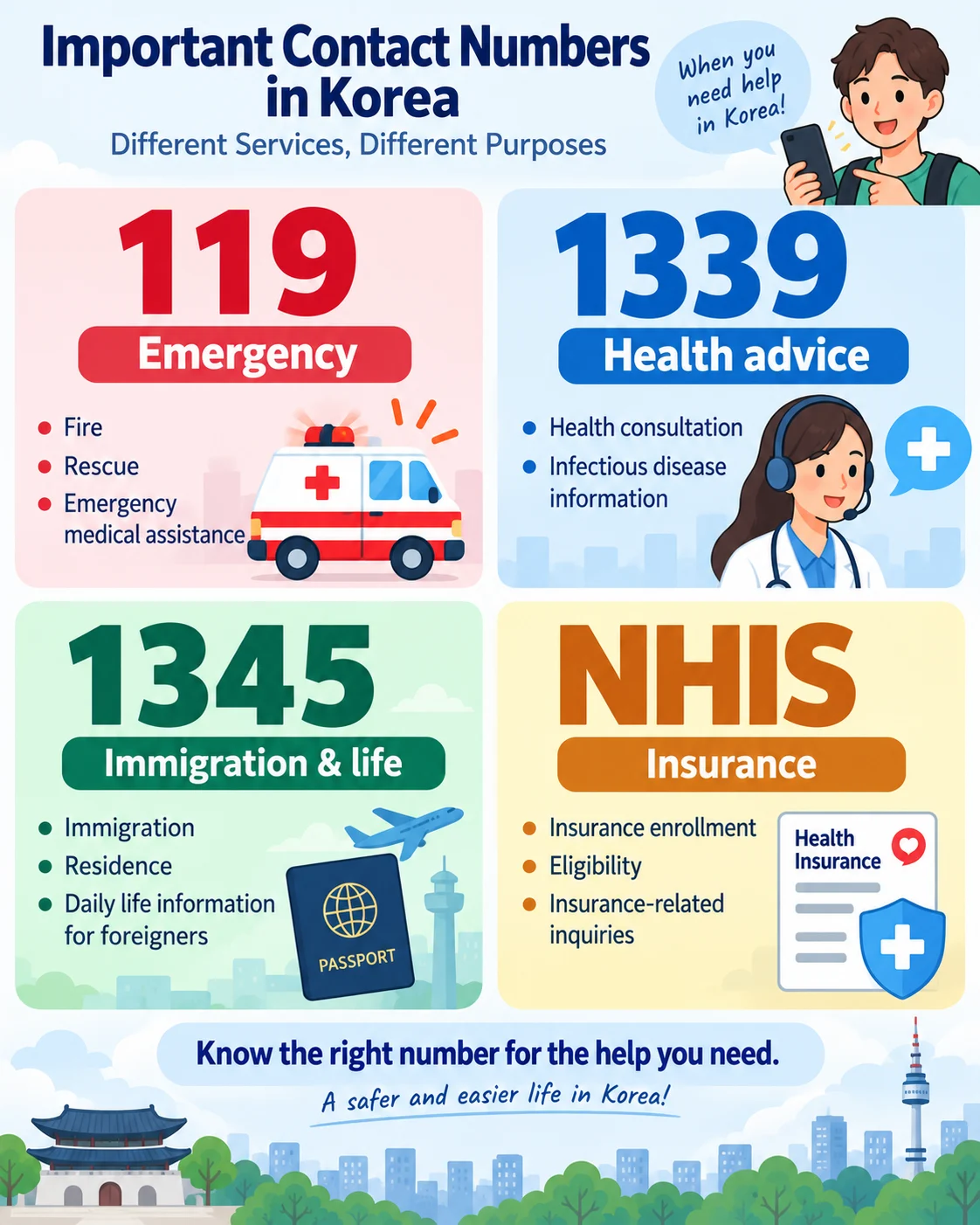
119 and 1339 have different purposes
When searching for health or daily-life information in Korea, you may also see 1339.
These services have different roles:
* 119: urgent rescue and emergency medical assistance * 1339: health and infectious-disease consultation * 1345: immigration, residence, and daily-life information for foreigners * National Health Insurance Service (NHIS): questions about health insurance enrollment and eligibility
The Korea Disease Control and Prevention Agency operates 1339. It provides health consultation and infectious-disease reporting and consultation 24 hours a day, 365 days a year.
KDCA also states that foreigners in Korea can access 1339 consultation through a three-way call connected through 1330 or 1345.
However, 1339 does not dispatch an ambulance. If urgent rescue or emergency medical assistance is needed, use 119.
Where should you go for medical care in Korea?
Korea has several types of medical facilities, including clinics, hospitals, general hospitals, and emergency departments.
If this is your first time receiving medical care in Korea, the difference between a `clinic` and a `hospital` may be confusing.
Under Korea’s Medical Service Act, clinic-level medical institutions mainly provide outpatient care, while hospital-level medical institutions mainly provide inpatient care.
This does not mean that a smaller clinic automatically provides lower-quality care. Their main functions are different.
For ordinary outpatient care, people often begin by looking for a nearby clinic-level medical institution.
You may still be unsure which medical department you should visit.
Instead of deciding on a diagnosis from symptoms you found online, you can ask the medical facility which department should handle your visit.
Korean: 한국어를 잘 못합니다. 어느 진료과에서 진료를 받아야 하는지 알려주세요.
Pronunciation help: Han-gu-guh-rul jal mo-tam-ni-da. Uh-neu jin-ryo-gwa-eh-suh jin-ryo-rul ba-da-ya ha-neun-ji al-lyuh-ju-se-yo.
Meaning: I don’t speak Korean well. Please tell me which medical department I should go to.
How to find a medical facility that is open
Instead of searching only by hospital name, official medical-facility search services can help you narrow down your options.
Finding a clinic, hospital, or pharmacy
The Emergency Medical Portal E-Gen allows you to search hospitals, clinics, and pharmacies by area, medical specialty, treatment date, and related conditions.
It can help you find a facility that may currently be operating, but actual hours can change.
If possible, contact the medical facility before leaving and confirm that it can see you.
Finding medical facilities with language support
Medical Korea allows users to search medical institutions frequently used by foreign patients and filter them by medical specialty and interpretation language.
Language filters include English, Chinese, Japanese, Vietnamese, Russian, Thai, and other languages.
However, Medical Korea is not a complete list of every medical institution in Korea that treats foreign patients.
Even when a language appears in the search results, interpreter availability and reservation requirements can vary by facility.
Check with the hospital before visiting.
If you want to ask whether interpretation is available:
Korean: 저는 한국어를 잘 못합니다. 외국어 통역 지원을 받을 수 있나요?
Pronunciation help: Juh-neun han-gu-guh-rul jal mo-tam-ni-da. Weh-gu-guh tong-yuhk ji-won-ul ba-dul su in-na-yo?
Meaning: I don’t speak Korean well. Is foreign-language interpretation support available?
For this English-language page, you can tell the staff exactly which language you use:
Korean: 제가 사용하는 언어는 영어입니다. 영어로 도움을 받을 수 있을까요?
Pronunciation help: Je-ga sa-yong-ha-neun uh-nuh-neun yung-uh-im-ni-da. Yung-uh-ro do-um-ul ba-dul su i-sul-kka-yo?
Meaning: I speak English. Could I get help in English?
What to say at the reception desk
When you arrive at a clinic or hospital, you will usually need to check in first.
You do not need to force yourself to explain everything in complicated Korean.
Start by telling the staff that you do not speak Korean well.
You can show this sentence directly on your phone.
Korean: 한국어를 잘 못합니다. 접수하는 방법을 천천히 알려주세요.
Pronunciation help: Han-gu-guh-rul jal mo-tam-ni-da. Juhp-su-ha-neun bang-bub-ul chun-chun-hi al-lyuh-ju-se-yo.
Meaning: I don’t speak Korean well. Please explain slowly how I should check in.
If you need an interpreter:
Korean: 한국어를 잘 못합니다. 통역 도움을 받을 수 있을까요?
Pronunciation help: Han-gu-guh-rul jal mo-tam-ni-da. Tong-yuhk do-um-ul ba-dul su i-sul-kka-yo?
Meaning: I don’t speak Korean well. Can I get help from an interpreter?
If you specifically want English-language help:
Korean: 제가 사용하는 언어는 영어입니다. 영어로 도움을 받을 수 있을까요?
Pronunciation help: Je-ga sa-yong-ha-neun uh-nuh-neun yung-uh-im-ni-da. Yung-uh-ro do-um-ul ba-dul su i-sul-kka-yo?
Meaning: I speak English. Could I get help in English?
If you want to know whether you can receive care now:
Korean: 지금 진료를 받을 수 있나요? 예약이 필요한가요?
Pronunciation help: Ji-geum jin-ryo-rul ba-dul su in-na-yo? Yeh-ya-gi pi-ryo-han-ga-yo?
Meaning: Can I receive medical care now? Do I need an appointment?
The identification or insurance documents requested at check-in may vary depending on the medical facility and your situation.
Do not assume that one particular document is required at every clinic or hospital in Korea.
If you are unsure, ask.
Korean: 접수하려면 어떤 서류가 필요한가요?
Pronunciation help: Juhp-su-ha-ryuh-myun uh-tteon suh-ryu-ga pi-ryo-han-ga-yo?
Meaning: What documents do I need to check in?
Health insurance status is different for each person
Not every foreign resident in Korea has the same health insurance status.
Your situation may differ depending on factors such as immigration status, employment, length of stay, and type of enrollment.
Do not assume that an online article can determine whether your own treatment will be covered.
To confirm your enrollment or eligibility, contact Korea’s National Health Insurance Service (NHIS).
The foreign-language contact information confirmed for this guide is:
* 1577-1000 → press 6 * 033-811-2000 * From outside Korea: +82-33-811-2001 * Hours: 09:00–18:00 * Languages: English, Chinese, Vietnamese, and Uzbek
These numbers are for questions about National Health Insurance, including enrollment and eligibility.
They are not medical interpretation numbers for conversations with your doctor during treatment.
If you want to ask about your health insurance at the hospital:
Korean: 제 건강보험 적용 여부를 확인하고 싶습니다. 어디에서 확인하면 되나요?
Pronunciation help: Je gun-gang-bo-hum juh-gyong yuh-bu-rul hwa-gin-ha-go ship-sum-ni-da. Uh-di-eh-suh hwa-gin-ha-myun dwe-na-yo?
Meaning: I would like to check whether my health insurance applies. Where can I confirm this?
What to do if you need an interpreter
Not every hospital has an interpreter available at all times.
First, check whether the hospital itself provides interpretation. You can also check whether your city or local foreign-resident support organization operates a separate service.
If you live, work, or study in Seoul, check MeSic
In 2026, Seoul operates the MeSic Medical Interpretation Support Program.
The confirmed operating period is February through December 2026, and the program may end early if its budget is exhausted.
It is available to foreign residents in Seoul who have difficulty using medical services. People who work or study in Seoul are also included. Treatment solely for cosmetic or plastic-surgery purposes is excluded.
A professional medical interpreter can accompany the patient and support check-in and payment, outpatient care, health examinations, medication instructions, and explanations of medical documents.
The program provides up to four free uses per person per year. Interpretation related to serious illness, detailed examinations, surgery, or hospitalization may receive priority.
The 10 confirmed languages for 2026 are:
English, Japanese, Chinese, Vietnamese, Cambodian, Thai, Russian, Mongolian, Arabic, and French.
There are several important limits.
You must arrange the hospital appointment first, and interpretation must be requested at least three days before the scheduled hospital visit.
Interpreter schedules may also make it impossible to match the exact date you want.
This is a Seoul support program, not a nationwide interpretation service available everywhere in Korea.
What is 1345?
The 1345 Immigration Contact Center provides multilingual information about immigration, residence, and practical daily life in Korea.
Its confirmed operating hours are weekdays from 09:00 to 22:00. After 18:00, service is mainly provided in Korean, English, and Chinese.
For some foreigner-related matters involving government agencies, local governments, public institutions, and nonprofit organizations, three-way interpretation is available.
However, do not assume that 1345 provides live medical interpretation at every private hospital.
What is 1330?
1330 is operated by the Korea Tourism Organization and provides tourism information and tourism interpretation.
Official information also includes connections to related services such as 119 and 1345 when necessary.
However, the official sources checked for this guide show inconsistent information about exact operating hours by language, so this article does not provide a fixed language-by-language timetable.
It should also not be treated as a professional medical interpretation service for hospital treatment.
When describing symptoms, focus on facts rather than guessing the diagnosis
You do not need perfect Korean to explain your condition to a doctor.
Rather than beginning with a diagnosis you found online, focus on what you are actually experiencing.
Before your appointment, it can help to write these details in your phone:
* Where you feel pain or discomfort * When it started * Whether it is continuous or comes and goes * Any medicine you currently take * Any medicine or food allergies
Instead of showing only a phrase such as `stomach pain`, use a complete sentence that matches your actual condition.
Korean: [오늘 아침/어젯밤/3일 전]부터 [배/머리/허리/목 등]가 아픕니다.
Pronunciation help: [Oh-neul a-chim / uh-jet-bam / sam-il juhn]-bu-tuh [beh / muh-ri / huh-ri / mok] ga a-pum-ni-da.
Meaning: My [stomach/head/back/throat, etc.] has hurt since [this morning/last night/three days ago].
If you know the location more precisely:
Korean: [왼쪽/오른쪽] [부위]가 아픕니다.
Pronunciation help: [Wen-jjok / oh-reun-jjok] [bu-wi] ga a-pum-ni-da.
Meaning: My [left/right] [body part] hurts.
If the symptom has continued:
Korean: 이 증상이 [시간 또는 기간] 동안 계속되고 있습니다.
Pronunciation help: Ee jeung-sang-ee [shi-gan tto-neun gi-gan] dong-an gye-sok-dwe-go it-sum-ni-da.
Meaning: This symptom has continued for [time or duration].
If you are currently taking medicine:
Korean: 현재 [약 이름]을 복용하고 있습니다.
Pronunciation help: Hyun-je [yak ee-reum]-ul bo-gyong-ha-go it-sum-ni-da.
Meaning: I am currently taking [medicine name].
If you are not taking any medicine:
Korean: 현재 복용 중인 약은 없습니다.
Pronunciation help: Hyun-je bo-gyong jung-in ya-geun up-sum-ni-da.
Meaning: I am not currently taking any medicine.
If you have an allergy:
Korean: 저는 [약 이름 또는 음식]에 알레르기가 있습니다.
Pronunciation help: Juh-neun [yak ee-reum tto-neun eum-shik]-eh al-le-ruh-gi-ga it-sum-ni-da.
Meaning: I am allergic to [medicine name or food].
Do not copy an example if it does not apply to you.
Only show information that is true for your situation.
Korean sentences you can show directly at the hospital
The sentences below are for situations where communicating in Korean is difficult.
Do not use a sentence if it does not match your actual situation.
At reception
Korean: 한국어를 잘 못합니다. 접수하는 방법을 천천히 알려주세요.
Pronunciation help: Han-gu-guh-rul jal mo-tam-ni-da. Juhp-su-ha-neun bang-bub-ul chun-chun-hi al-lyuh-ju-se-yo.
Meaning: I don’t speak Korean well. Please explain slowly how I should check in.
When you need interpretation
Korean: 한국어를 잘 못합니다. 통역 도움을 받을 수 있을까요?
Pronunciation help: Han-gu-guh-rul jal mo-tam-ni-da. Tong-yuhk do-um-ul ba-dul su i-sul-kka-yo?
Meaning: I don’t speak Korean well. Can I get help from an interpreter?
When you need help in English
Korean: 제가 사용하는 언어는 영어입니다. 영어로 도움을 받을 수 있을까요?
Pronunciation help: Je-ga sa-yong-ha-neun uh-nuh-neun yung-uh-im-ni-da. Yung-uh-ro do-um-ul ba-dul su i-sul-kka-yo?
Meaning: I speak English. Could I get help in English?
If you do not know which department to visit
Korean: 어느 진료과에서 진료를 받아야 하는지 모르겠습니다. 어디로 가야 하는지 알려주세요.
Pronunciation help: Uh-neu jin-ryo-gwa-eh-suh jin-ryo-rul ba-da-ya ha-neun-ji mo-ru-get-sum-ni-da. Uh-di-ro ga-ya ha-neun-ji al-lyuh-ju-se-yo.
Meaning: I don’t know which medical department I should visit. Please tell me where I need to go.
When explaining a symptom
Korean: [언제]부터 [어디]가 아픕니다.
Pronunciation help: [Uhn-je]-bu-tuh [uh-di] ga a-pum-ni-da.
Meaning: My [body part] has hurt since [time].
Korean: 이 증상이 [기간] 동안 계속되고 있습니다.
Pronunciation help: Ee jeung-sang-ee [gi-gan] dong-an gye-sok-dwe-go it-sum-ni-da.
Meaning: This symptom has continued for [duration].
When telling staff about current medicine
Korean: 현재 [약 이름]을 복용하고 있습니다.
Pronunciation help: Hyun-je [yak ee-reum]-ul bo-gyong-ha-go it-sum-ni-da.
Meaning: I am currently taking [medicine name].
Or:
Korean: 현재 복용 중인 약은 없습니다.
Pronunciation help: Hyun-je bo-gyong jung-in ya-geun up-sum-ni-da.
Meaning: I am not currently taking any medicine.
When telling staff about an allergy
Korean: 저는 [약 또는 음식 이름]에 알레르기가 있습니다.
Pronunciation help: Juh-neun [yak tto-neun eum-shik ee-reum]-eh al-le-ruh-gi-ga it-sum-ni-da.
Meaning: I am allergic to [medicine or food name].
If you do not understand the doctor
You do not need to pretend that you understood something you did not.
Korean: 설명을 이해하지 못했습니다. 쉬운 말로 다시 설명해 주세요.
Pronunciation help: Suhl-myung-ul ee-he-ha-ji mo-tet-sum-ni-da. Shee-un mal-lo da-shi suhl-myung-he ju-se-yo.
Meaning: I did not understand the explanation. Please explain it again in simpler words.
If you do not understand what test you are having:
Korean: 어떤 검사를 받는지 다시 설명해 주세요.
Pronunciation help: Uh-tteon gum-sa-rul bat-neun-ji da-shi suhl-myung-he ju-se-yo.
Meaning: Please explain again what test I am going to have.
If you do not know how to prepare for the test:
Korean: 검사 전에 무엇을 준비해야 하는지 다시 알려주세요.
Pronunciation help: Gum-sa juh-neh mu-uht-ul jun-bi-he-ya ha-neun-ji da-shi al-lyuh-ju-se-yo.
Meaning: Please tell me again what I need to prepare before the test.
If you do not understand the prescription
Korean: 처방받은 약을 어떻게 먹어야 하는지 다시 설명해 주세요.
Pronunciation help: Chuh-bang-ba-deun ya-gul uh-tteo-ke muh-guh-ya ha-neun-ji da-shi suhl-myung-he ju-se-yo.
Meaning: Please explain again how I should take the medicine I was prescribed.
After the appointment: prescription and pharmacy
The process may continue after you finish seeing the doctor.
When a doctor prescribes medication during outpatient care, the usual process is to receive a prescription and have the medicine dispensed at a pharmacy.
Under Korea’s Pharmaceutical Affairs Act, medicines prescribed by a doctor or dentist are, in principle, dispensed by a pharmacist according to the prescription.
There are exceptions, so do not assume that every patient must always collect medicine from a pharmacy outside the hospital. Follow the instructions provided by the medical facility.
If you are unsure whether you received a prescription:
Korean: 제가 약국에 가져가야 하는 처방전이 있나요?
Pronunciation help: Je-ga yak-gu-geh ga-jyuh-ga-ya ha-neun chuh-bang-juhn-ee in-na-yo?
Meaning: Is there a prescription that I need to take to a pharmacy?
At the pharmacy:
Korean: 이 처방전으로 약을 받고 싶습니다.
Pronunciation help: Ee chuh-bang-juhn-eu-ro ya-gul bat-go ship-sum-ni-da.
Meaning: I would like to get the medicine for this prescription.
If you do not fully understand how to take the medicine, ask again before leaving the pharmacy.
Korean: 이 약은 언제 먹어야 하나요?
Pronunciation help: Ee ya-geun uhn-je muh-guh-ya ha-na-yo?
Meaning: When should I take this medicine?
Korean: 하루에 몇 번 먹어야 하나요?
Pronunciation help: Ha-ru-eh myuht bun muh-guh-ya ha-na-yo?
Meaning: How many times a day should I take it?
Korean: 한 번에 얼마나 먹어야 하나요?
Pronunciation help: Han bun-eh uhl-ma-na muh-guh-ya ha-na-yo?
Meaning: How much should I take each time?
This guide cannot decide the medicine name, amount, or dosage for you.
Confirm the actual prescription and instructions with your doctor and pharmacist.
Before leaving for the hospital, save these details on your phone
You do not need perfect Korean.
It is more useful to have the facts that medical staff may need in order to understand your situation.
Before leaving, check whether you have:
* A document you may be able to use if the hospital needs to confirm your identity or insurance * The names of medicines you currently take * Information about medicine or food allergies * Your main symptom * The date and time the symptom started * The location of the pain or discomfort * A person you can contact if necessary * Information about any interpretation service you may be able to use
If you plan to use Seoul’s MeSic service, remember that it is not designed for same-day requests made while you are already going to the hospital.
You must arrange the hospital appointment first and request interpretation at least three days before the scheduled visit.
Even if you find a medical facility through E-Gen or Medical Korea, confirm actual operating hours and interpreter availability with the facility before you go.
Even without perfect Korean, preparing accurate information about where you hurt, when the problem started, what medicine you currently take, and what allergies you have can help medical staff understand your situation.
You do not need to pretend that you understood something when you did not.
If necessary, show your phone screen and ask for the explanation again.
Official sources to check
* [Seoul Foreign Resident Portal — 2026 MeSic Medical Interpretation Support Program](https://global.seoul.go.kr/web/news/news/bordContDetail.do?brd_no=2&lang=ko&mode=W&post_no=4F05322B716701CCE063C0A8A023D597) * [National Health Insurance Service — Foreign-language contact information](https://www.nhis.or.kr/english/wbheaa02000m01.do) * [Korea Disease Control and Prevention Agency — 1339 Call Center](https://www.kdca.go.kr/kdca/2777/subview.do) * [Medical Korea — Medical institution search for foreign patients](https://www.medicalkorea.or.kr/en/mostvisitedmedicalinstitutions) * [Korean Law Information Center — Medical Service Act](https://www.law.go.kr/)
Information about 119, 1345, 1330, and E-Gen was also checked against publicly available information from the responsible official agencies as of September 16, 2026.
Information check and update record
* Information checked as of: September 16, 2026 * Last rechecked: September 16, 2026 * Sources checked: Seoul Foreign Resident Portal, National Health Insurance Service, Korea Disease Control and Prevention Agency, Ministry of Justice, National Fire Agency, Korea Tourism Organization, Medical Korea, E-Gen, and the Korean Law Information Center * Changes confirmed: NHIS foreign-language consultation currently uses option 6 after calling 1577-1000. The 2026 MeSic language list differs from materials from earlier years, so this article uses the 10 languages listed for 2026. 1339 is treated as a health and infectious-disease consultation line, not an emergency rescue dispatch number. * Information to recheck when relevant: possible early closure of MeSic if the budget is exhausted, the NHIS foreign-language ARS option, 1330 operating hours by language, and interpreter availability and hours at individual hospitals
This article was prepared using publicly available information found on the relevant official websites as of September 16, 2026.
Program availability, call-routing methods, hospital operating hours, and interpreter availability can change. Check with the relevant organization or medical facility again before using the service.
살아는 봅시다.